


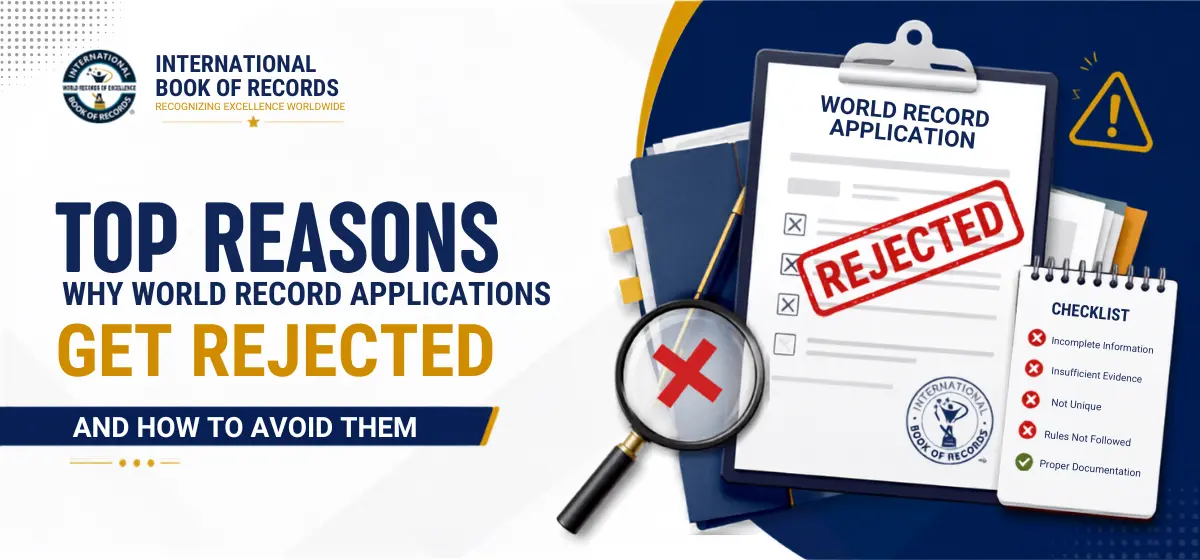
One of the most wonderful ways to honor a unique talent or success is to see your name in a record book. If you are applying for the International Book of Records the process demands considerable preparation. And the sad reality is that many applications are turned down each year, not because the achievement isn’t great, but because of simple blunders.
If you’re serious about becoming recognized, the first step to ensuring your application doesn’t fail is knowing why applications fail.
1. The Achievement Is Not Quantifiable
This is one of the most typical causes for rejection with all record organizations. As a good rule of thumb, if you can’t measure, weigh or count anything, it is generally not a record. Awards like “most creative performance” or “most inspiring journey” are too broad. Your record should have a real, tangible result – a number, a time, a distance, or a weight.
How to prevent it:
Before you apply, you need to ask yourself: can this be measured objectively?’ If the answer is yes, you’re on the right path.
2. Poor or Ambiguous Documentation
In case the documentation you give is ambiguous or insufficient, your claim can be declined. Record labels have to fact-check you. Rejection based on missing witness statements, hazy recordings, no timestamps, no signatures on declarations, etc.
How to stop it:
Offer comprehensive, well-structured documentation. Include video proof, signed testimonies from two independent witnesses and supporting certificates. Make sure all parts of the application form are filled in correctly.
3. An Existing Record Has Been Exceeded
To go for a record that is already held by someone else is pointless unless you are aiming to beat it with a superior outcome. Sometimes applications are denied from the outset if there is no category or if there is a pre-existing record that beats the claim submitted.
How to prevent:
Do your research before you apply. Check the databases of the official registry you are applying to. If there is a record, see to ensure that you break it by a big margin.
4. The Attempt Cannot Be Standardized
Record bodies need to be able to set clear standards so future challengers can try the same record under the same conditions. If the suggestion is not standardizable, it will be rejected – e.g., improvisations or jam sessions where it is impossible to maintain consistency in quality or measurement.
How to prevent it:
Make your record repeatable somehow. If it is based only on your personal interpretation of conditions, it will not be approved.
5. Evidence That Does Not Meet Verification Standards
Rejections are typically due to a lack of proof, duplication, or a rule infringement. This includes poor-quality video, no independent adjudicator, no third-party verification or evidence that does not properly record the entire endeavor from beginning to end.
How to prevent it:
Photograph your attempt from several angles. Have real witnesses on hand. Make sure timestamps are visible. If feasible, have the claim certified by a notary or impartial body.
6. Safety and Legal Issues
Any attempt involving risk of life, destruction of property or crimes of law shall be disqualified immediately. Cancellation will be done for any significant breach of law, death, injury to life or property or wastage of food.
How to prevent it:
Make your attempt with safety as a non-negotiable. If using public areas, get authorization and verify that your endeavor does not put you or others in danger.
Quick Comparison: What Different Record Bodies Look For – Criteria
The International Book of Records looks at a number of major requirements before approving any record attempt:
Criteria | International Book of Records Criteria |
| Measurable Outcome | Yes. The record must be visible, measurable and auditable. |
| Independent Witnesses | Required to witness the effort. |
| Photographic and Video Evidence | Applicants are requested to provide strong visual documentation of the project. |
| Age Eligibility | Open to participants of varying age groups, with guidelines relevant to each category. |
| Processing Time | Varies, based on type and thoroughness of supplied evidence. |
| Safety Standards | All record attempts must comply with safety rules. |
Preparation can be the difference between an application that gets denied and an application that gets approved. Success is not measured by success itself, but by the record of success. To raise your chances of being officially acknowledged, follow International Book of Records criteria carefully, compile good proof and make a detailed application.
World Record Application FAQs
Why do most first-time applications get denied?
Many first-time applicants underestimate the amount of documentation required. A tremendous achievement is not enough in itself – the proof must be comprehensive, properly documented and independently confirmed. The number one reason applications fail is because you go in underprepared.
Can I reapply if I get a rejection?
Yes, most of the time. If your application was denied because of missing documentation or a technicality, you can fix the problem and reapply. Read the rejection reason attentively and use it as a checklist for your next submission.
Does my record have to be a world first?
Not all the time. If you can beat the result of the current holder, you can try to break a record. You can also propose a new category – but these are subject to greater inspection to ensure they are standardizable and verifiable.
How long does it take to process my application?
Depends on the organization. Some organizations will take up to 12 weeks to examine an application, but they do offer a priority service to speed up the process. Once the proof is submitted, the India Book of Records usually takes a few working days to process the claims.
What is most crucial to get correct in an application?
Your proof. All record bodies have documentation as the primary focus. A well-filmed, clearly time-stamped, independently observed effort presented with a thorough and correct application has the best chance of approval.